
Before a commercial building, warehouse, retail center, subdivision, or industrial facility can take shape, the ground has to be prepared for what comes next. That process often involves moving large amounts of soil, establishing elevations, preparing building areas, and creating the basic shape of the site.
For developers and general contractors, understanding the difference between mass grading and rough grading can make early site planning easier.
A mass grading contractor in DFW TX may be needed when a large commercial property requires significant cut and fill work across the site. Rough grading, on the other hand, generally focuses on bringing specific areas closer to planned elevations before later construction and finish work.
Southern Land Specialist provides excavation and grading services for commercial and residential projects throughout Wise County and the DFW Metroplex.
If you are asking what mass grading is in construction, think of it as large-scale earthmoving that establishes the overall shape and elevations of a development site.
Instead of adjusting one small section of land, mass grading services can involve moving substantial quantities of soil across a larger property.
The goal is to create a workable site based on the project plans before roads, buildings, parking areas, utilities, drainage features, and other improvements are completed.
Mass grading may involve:
Mass excavation & grading is commonly associated with larger developments because the existing terrain may need significant modification before vertical construction can begin.
Not every commercial property requires major earthmoving.
A relatively flat property with suitable elevations may need only limited grading. A larger tract with slopes, drainage challenges, elevation differences, or multiple building areas may require considerably more site work.
Mass grading is often useful when preparing:
The amount of work depends on the site's existing topography and the approved construction plans.
A commercial project may require high sections of the property to be excavated while lower sections receive suitable fill.
Balancing cut and fill efficiently can reduce unnecessary soil handling and help create the elevations needed for later construction.
Commercial sites with multiple structures may require broad grading before individual building pads and access areas are prepared.
This is where experienced mass grading services become important. The earthwork has to support the overall construction sequence, not just one isolated area.
Rough grading is the process of shaping the land closer to the planned elevations before final surfaces are completed.
It creates the general grade needed for later construction work.
Rough grading may occur after major clearing and excavation or as part of a larger grading operation.
Common rough grading tasks include:
The finished surface is not necessarily smooth enough for landscaping or final use.
The purpose is to create the correct general shape so later stages can move forward.
Understanding rough grading vs final grading is important, but commercial site managers should first understand how rough grading relates to mass grading.
Mass grading focuses on large-scale earth movement across a property. Rough grading focuses more on getting portions of the site close to their planned shape and elevation.
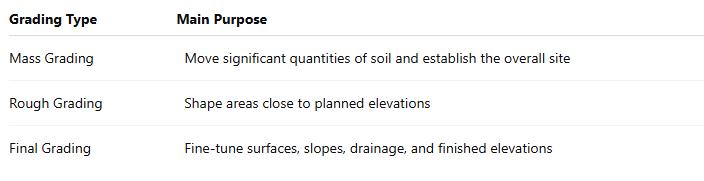
A large development may require all three stages.
Imagine a commercial property with uneven terrain.
Mass excavation & grading may first move soil from higher areas to lower portions of the site. Rough grading can then establish the approximate building pad, parking, and access elevations.
Later, final grading brings surfaces to the more precise elevations needed before paving, landscaping, drainage completion, or other finish work.
Completing grading in the correct sequence helps reduce unnecessary rework.
If large amounts of dirt still need to be moved after detailed finish work begins, equipment may disturb areas that were already prepared.
Planning the earthwork around the construction schedule can help keep the site more organized.
Rough grading and final grading serve different purposes.
Rough grading creates the basic shape of the property. Final grading focuses on precision and the finished condition of specific areas.
Commercial site grading in Texas often involves multiple grading phases because large projects are built in stages.
Drainage should be considered throughout the grading process.
Changing site elevations changes how water moves across a property. Large commercial developments can also include roofs, parking lots, roadways, and other surfaces that affect runoff.
Grading should follow the project's approved plans and drainage requirements.
Poorly planned earthwork can create unwanted low areas or interfere with future drainage features.
A mass grading contractor in DFW TX should understand how their portion of the work connects with the broader site plan, engineering requirements, building pads, access roads, and utility installation.
Heavy earthmoving cannot begin efficiently when the site is still covered with trees, brush, stumps, or old structures.
Commercial site preparation may start with land clearing services to open the construction footprint and create equipment access.
Clearing may include:
Some properties may also contain existing structures that need to be removed before grading begins. Southern Land Specialist provides demolition services when structure removal is part of the larger site preparation plan.
Coordinating these services can simplify the transition from an undeveloped property to an active construction site.
Mass grading does not have a reliable one-price-fits-all cost.
Commercial properties can differ dramatically in acreage, elevation, soil movement, access, and project requirements.
Important pricing factors may include:
A site that can balance much of its soil internally may have different hauling needs than a property requiring large amounts of material to be imported or exported.
An accurate proposal should be based on the actual plans and site conditions.
Not all grading projects require the same equipment, planning, or capacity.
When comparing grading service providers for commercial sites, developers and contractors should look beyond a basic hourly equipment rate.
Useful questions include:
The proposal should clearly define what is included so the general contractor or property owner understands where one contractor's responsibility ends and the next construction phase begins.
You can view examples of Southern Land Specialist's completed site work when evaluating the company's experience with excavation, clearing, grading, and related land services.
North Texas development includes everything from smaller commercial pads to large multi-acre sites.
The right grading approach depends on the actual property.
A commercial site may require clearing followed by mass grading, rough grading, utility excavation, pad preparation, and final grading at different stages.
Southern Land Specialist works with builders, developers, general contractors, and property owners throughout Wise County and the greater DFW area.
Commercial clients can also review Southern Land Specialist customer feedback on Google when researching a local excavation and grading company.
Commercial grading sets the foundation for nearly everything that follows on a development site.
Whether your project needs large-volume earthmoving, commercial site grading, rough grading, or preparation for building pads, the first step is understanding the existing property and the planned finished elevations.
Southern Land Specialist can evaluate the project scope and coordinate excavation, clearing, grading, and related site preparation work.
If you are looking for a mass grading contractor in DFW TX for a commercial development in Wise County or the surrounding Metroplex, contact Southern Land Specialist to discuss your project and request a quote.
Mass grading is large-scale earthwork that changes the overall elevations and shape of a development site. It can involve excavating high areas, filling low areas, moving soil across the property, and preparing broad sections of land for future construction.
Mass grading focuses on moving larger quantities of soil across a site to establish the general development layout. Rough grading brings specific areas closer to their planned elevations and slopes before more precise finish work begins.
Rough grading establishes the basic shape, elevations, and slopes of the property. Final grading makes smaller, more precise adjustments to prepare surfaces for their finished use and drainage requirements.
Many do. Trees, brush, stumps, debris, and existing structures can interfere with grading equipment and earthmoving. Clearing the required construction area first can make excavation and grading more efficient.
Mass grading may be required for warehouses, retail developments, industrial properties, multifamily projects, commercial buildings, subdivisions, large parking areas, and other sites where substantial amounts of soil must be moved.
The cost depends on acreage, cut and fill quantities, soil conditions, hauling, material import or export, equipment requirements, accessibility, compaction needs, and project schedule. Reviewing the actual site and construction plans is the best way to develop an appropriate quote.
Southern Land Specialist provides excavation, grading, mass grading, land clearing, and related site preparation services for commercial projects throughout Wise County and the greater DFW Metroplex.


