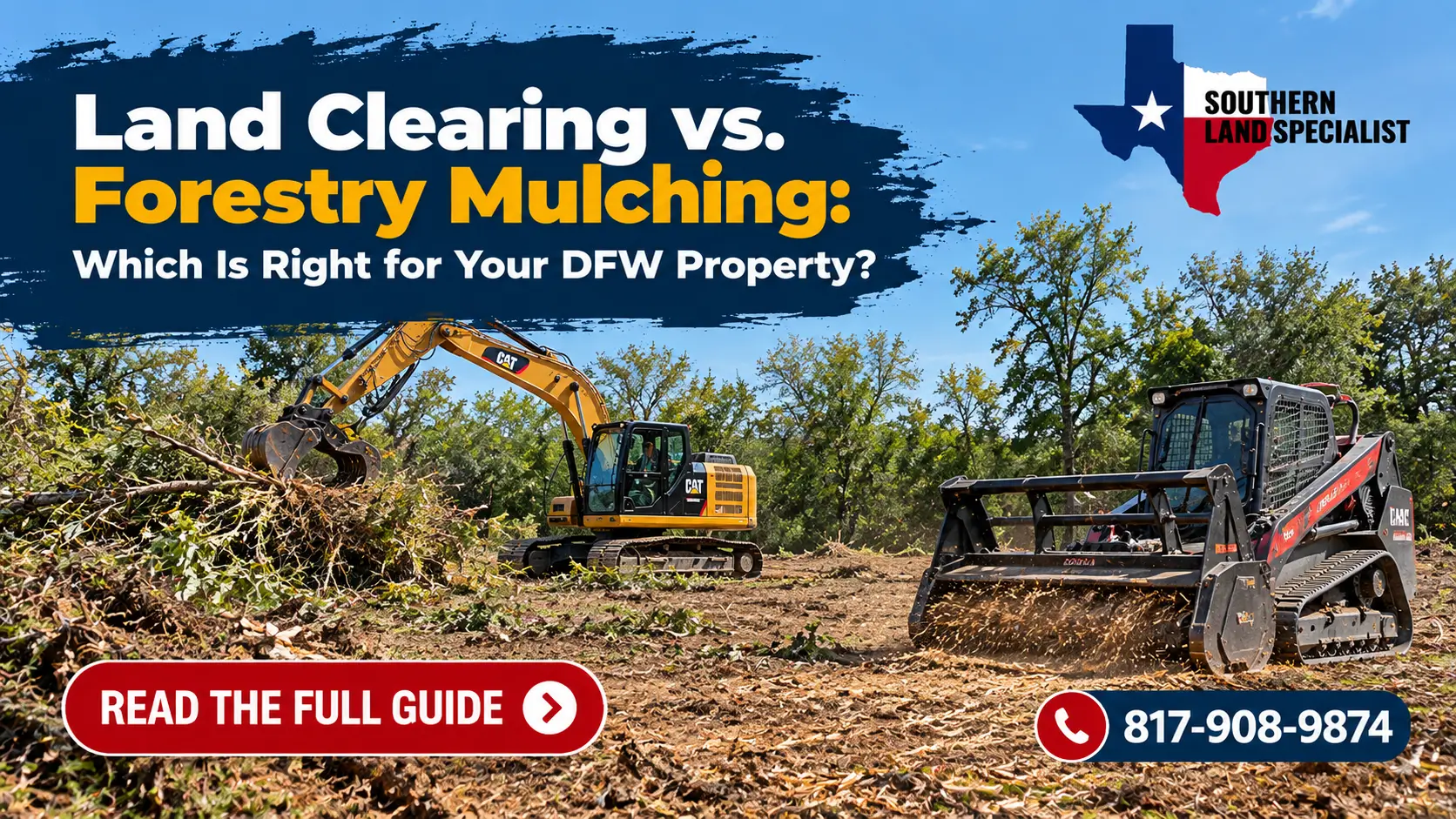
Clearing an overgrown property can mean very different things depending on what you plan to do with the land afterward. A homeowner preparing acreage for a new house has different needs than someone who simply wants to open trails, clean up brush, or improve access around a rural property.
That is why the land clearing vs forestry mulching decision should start with the end goal.
Traditional land clearing can remove trees, stumps, roots, brush, and debris to create a more construction-ready surface. Forestry mulching grinds vegetation in place and leaves the processed material across the ground.
Both methods can be useful, but they produce different results.
Southern Land Specialist provides land clearing services throughout Wise County and the DFW area for residential, commercial, and construction-related projects.
If you are asking what forestry mulching is, it is a vegetation management method that uses specialized equipment to grind trees, saplings, brush, and other growth into smaller pieces.
The processed material is typically left on the property rather than loaded into trucks and hauled away.
Forestry mulching is commonly used for:
Because material is processed where it stands, forestry mulching can reduce the amount of debris that needs to be hauled off-site.
Forestry mulching does not produce the same finished surface as full land clearing and grubbing.
Depending on the machine and vegetation, the process typically leaves:
That may be perfectly acceptable for general vegetation management.
It may not be enough if a house pad, driveway, commercial building, foundation, or utility route is planned in the same area.
Traditional land clearing is a broader approach that can remove vegetation and other obstacles from a site rather than simply reducing them in place.
A land clearing project may involve:
Southern Land Specialist also provides tree removal services when larger trees need to be removed from construction areas, driveways, or other portions of a property.
Traditional clearing is often chosen when the land needs to support additional construction work afterward.
When land clearing methods are compared, the biggest difference is not simply the equipment being used. It is the condition of the property after the work is finished.
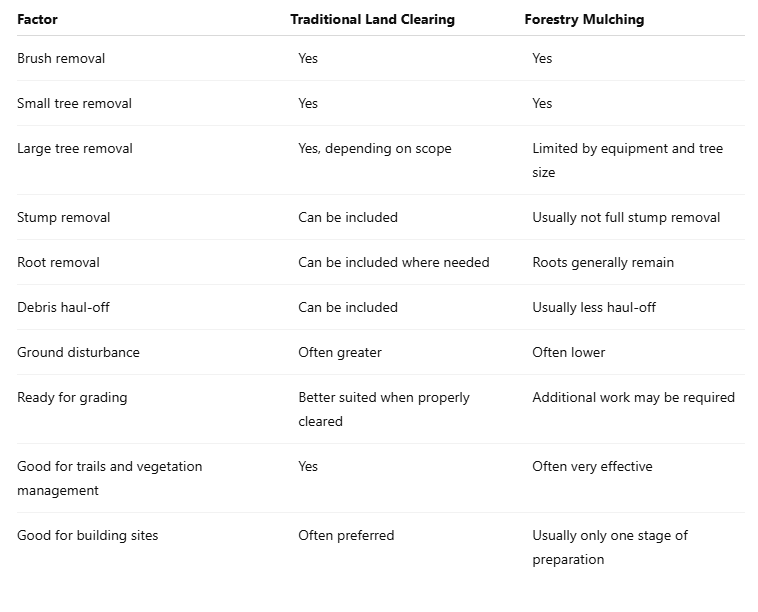
Neither method is automatically better.
The property owner's next step determines which approach makes more sense.
Forestry mulching can work well when the main goal is reducing vegetation rather than preparing bare ground for construction.
Thick brush can make rural property difficult to walk, inspect, or maintain.
Mulching can open visibility while processing smaller vegetation directly on-site.
Property owners may use forestry mulching to create trails through wooded sections without fully clearing the surrounding land.
Brush and small trees growing along fencing can make inspection and repair difficult.
Depending on vegetation size and access, mulching may help reopen these areas.
Some owners want to reduce heavy vegetation while keeping the wooded character of their land.
Forestry mulching may offer a middle ground between leaving dense brush untouched and completely clearing the property.
Full land clearing becomes more useful when vegetation is standing where construction, excavation, or grading needs to happen.
A future house pad generally needs more than surface vegetation removal.
Trees, stumps, roots, and unsuitable organic material within critical construction areas may need to be removed before excavation and grading can continue.
Commercial sites may require broader clearing for:
Leaving buried stumps or large roots in these areas can interfere with later site work.
Driveways and utility trenches also require more deliberate preparation than simply mulching the vegetation above the ground.
When excavation follows clearing, the contractor should understand what the area will ultimately support.
Property owners frequently ask how much does forestry mulching cost per acre in Texas.
There is no dependable one-price answer because vegetation can vary dramatically from one acre to another.
For early budgeting, current Texas contractor pricing often places forestry mulching somewhere around $1,500 to $6,000 per acre, with many projects falling inside that broad range.
The price can change based on:
A lightly overgrown five-acre tract may cost much less per acre than one acre packed with dense cedar and larger trees.
Contractors may also have minimum mobilization or daily charges.
That means multiplying an advertised per-acre figure by the exact acreage does not always produce an accurate project budget.
An on-site evaluation is more useful when the property has mixed vegetation or unusual access conditions.
Traditional clearing also varies widely because the finished scope can be very different.
Removing brush alone is not comparable to removing mature trees, pulling stumps, hauling debris, and preparing the same property for grading.
Cost factors include:
If grading or excavation will immediately follow, it is often useful to discuss both stages together.
Southern Land Specialist provides excavation and grading services when a cleared property also needs dirt work for construction.
There is no universal best land clearing method in Texas.
The better question is: what condition does the property need to be in when the job is complete?
Land clearing methods compared on paper can look like competing options, but real properties are often more complicated.
One part of a property may need complete clearing for a house and driveway, while surrounding acreage only needs lighter vegetation management.
A site-specific approach can avoid unnecessary work while still preparing critical construction areas correctly.
Brush hogging is another option for certain properties.
It is generally better suited to tall grass, weeds, and lighter brush than to heavily wooded areas.
Southern Land Specialist offers brush hogging services for properties where the vegetation does not require full clearing.
Understanding the vegetation before choosing equipment can help avoid paying for a heavier clearing method than the property actually needs.
Before hiring a contractor, think about what will happen after the clearing equipment leaves.
Ask yourself:
These questions can help define the correct scope.
A contractor should also inspect tree size, vegetation density, access, terrain, and any obstacles before recommending a method.
Property owners sometimes start by asking which machine should be used.
It is usually more helpful to start with the desired result.
If you need an open trail, the solution may be relatively simple.
If you need land prepared for a new home, the scope may include clearing, stump removal, excavation, drainage work, and grading.
Southern Land Specialist works across these stages, helping property owners plan around the intended use of the site rather than treating clearing as an isolated task.
You can view examples of Southern Land Specialist's completed land projects to see previous clearing, dirt work, and site preparation projects.
Property owners can also read Southern Land Specialist customer reviews on Google when researching a local land contractor.
The right answer to land clearing vs forestry mulching depends on what is growing on the property and what you plan to build, improve, or maintain afterward.
For construction sites, full clearing may provide the cleaner starting point needed for excavation and grading. For vegetation management, trails, or lighter property improvement, a less intensive approach may be more appropriate.
Southern Land Specialist serves Wise County and the greater DFW area with land clearing, tree removal, brush management, excavation, grading, and related site preparation.
If you are deciding how to clear your property, contact Southern Land Specialist to discuss the site and request a project quote.
Forestry mulching uses specialized equipment to grind brush, saplings, and trees into smaller material that is generally left on the ground. It is commonly used for vegetation management, trails, overgrown acreage, and access improvement.
It can be for some projects because less debris may need to be collected and hauled away. Cost depends on vegetation density, tree size, acreage, terrain, equipment, and the desired finished condition.
A broad planning range is approximately $1,500 to $6,000 per acre, but actual pricing varies significantly. Dense vegetation, larger trees, difficult terrain, and small-project minimums can increase the effective per-acre cost.
Forestry mulching generally does not provide the same full stump and root removal as traditional clearing and grubbing. If the area will become a building pad, driveway, or other construction zone, additional stump removal may be necessary.
Traditional land clearing is often better suited to the actual construction footprint because trees, stumps, roots, and organic material may need to be removed before excavation and grading.
It depends on the intended use. Forestry mulching can work well for vegetation management and trails, while more complete land clearing may be appropriate for homesites, commercial development, driveways, and areas that require grading.
Yes. Southern Land Specialist provides land clearing as well as excavation and grading services throughout Wise County and the DFW area, allowing related site preparation work to be coordinated based on the property and project scope.


